



Table of Contents
Cloud cost drift and cybersecurity pressure now compete with AI experiments, remote work, aging systems, and recurring support tickets for the same budget. When technology decisions react only to urgent issues, organizations get duplicated tools and unclear ownership. Weak integrations and rising operational noise often follow. Developing an IT strategy starts with business priorities before tools. The UK Cyber Security Breaches Survey 2024 found that 50% of businesses and 32% of charities reported a breach or attack in the previous 12 months, while surveyed executives say AI investment has grown to about 12% of IT spend in 2024.
Jason Stitt, Co-Founder at IT Force, notes: "Start with the tickets, approvals, and access requests people use every day because those details show where strategy must remove friction first."
Useful strategy starts with ownership, support evidence, security awareness, and a steady review rhythm.
What Is An IT Strategy In Practical Business Terms
An IT strategy for business is a decision framework for how technology supports growth and resilience. It also supports productivity, customer experience, and risk control. It clarifies whether a request is a strategic priority, a roadmap item, a replacement cost, or a backlog task. It also sets decision rules for Microsoft 365, Active Directory, and Exchange. The same rules guide networks, support workflows, and risk ownership.
Key examples of this include:
-
Strategy sets direction: It explains why systems need investment and which business outcomes each investment supports.
-
Roadmaps sequence work: They turn priorities into timed initiatives with owners, dependencies, and review dates.
-
Budgets fund choices: They show which priorities have funding and which requests need tradeoffs.
-
Backlogs track tasks: They hold tickets, fixes, access requests, and smaller improvements without replacing planning.
How To Develop An IT Strategy From Business Goals First
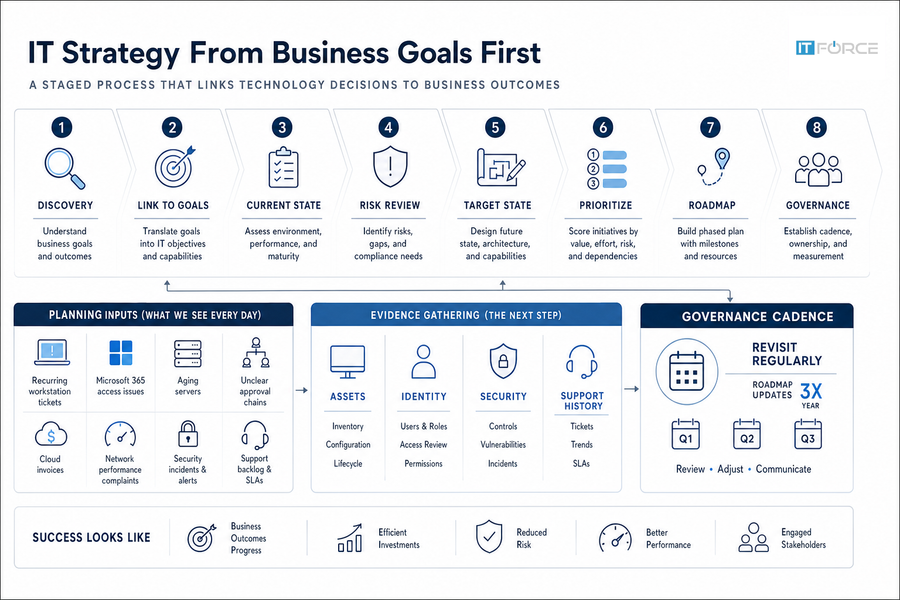
Start with discovery and business alignment. Then review current state, risk, target state, and priorities. The process should end with roadmap creation and governance. When developing IT strategy, that discipline matters because a Gartner report suggests only 23% of CIOs rate their organization as effective at business strategy and planning. A practical strategy cycle can revisit priorities three times a year so planned work stays aligned with support demand, growth priorities, security risk, and available budget.
What this looks like in practice: Recurring workstation tickets and Microsoft 365 access issues become planning inputs. Aging servers, unclear approval chains, cloud invoices, and network performance complaints show where daily work is losing time.
The next step is to turn those patterns into evidence leaders can act on. Asset data, identity controls, security findings, and support history show where the plan should focus first.
Developing IT Strategy With The Right Evidence
Strategy should not be built from opinion alone. The answer to what is an IT strategy becomes clearer when leaders review evidence that shows what to standardize, modernize, retire, or protect first.
-
Asset and application inventory. Workstations, servers, and business applications reveal unsupported systems and duplicate tools. They also show equipment that creates avoidable tickets.
-
Contracts and renewal dates. Vendor agreements, license terms, and cloud invoices show cost deadlines. They also expose tools that renew automatically without a clear owner.
-
Support ticket history. Standardized ticket records show repeated password issues, printer failures, onboarding delays, and access problems.
-
Security and backup status. Monitoring, backup checks, and endpoint alerts show protection gaps. Those gaps need control before new projects expand exposure.
-
Core platform health. Active Directory, Microsoft 365, and Exchange show core platform health. Server monitoring, workstation monitoring, and network management show whether the environment can support growth.
An IT Strategy For Business Needs Clear Governance And Security
Governance keeps an IT development strategy from becoming static. It defines who approves a new application, who owns risk for customer data, who funds network upgrades, and when priorities are reviewed. Security belongs in the design from the start, especially where monitoring, escalation, and compliance discipline affect daily operations. IBM reported that the global average breach cost reached USD 4.99 million in 2026, and NIST released Cybersecurity Framework 2.0 on February 26, 2024.
Governance also creates a common language for structured communication. A request for a new application, a privileged Active Directory change, or a security exception should move through defined approval steps. In regulated environments such as defense, aerospace, and nuclear, that discipline supports compliance as well as reliability.
|
Strategy layer |
Question it answers |
Evidence to collect |
|
Business alignment |
What outcomes must technology support? |
Growth plans and process pain |
|
Technology baseline |
What works and what creates drag? |
Asset data and support history |
|
Risk posture |
What must be protected first? |
Security findings and compliance needs |
|
Roadmap |
What should happen next? |
Priorities and dependencies |
An IT Development Strategy Roadmap That Can Be Executed
Strategy sets direction, while the roadmap turns that direction into sequenced work with owners and review dates. It also clarifies dependencies and funding needs. IBM found that advanced organizations report effective strategy execution at 63%, compared with 46% of less advanced organizations. Knowing how to develop an IT strategy also means planning for urgent support issues that interrupt scheduled work.
Operational change is difficult when urgent fixes keep pulling people away from planned improvements, so the roadmap needs practical sequencing.
Examples of this idea are:
-
Stabilize support first: Reduce recurring workstation, Microsoft 365, Exchange, and network tickets before adding automation.
-
Improve identity controls: Strengthen Active Directory access controls before expanding remote access or adding cloud applications.
-
Review cloud workloads: Validate costs, permissions, backup needs, and performance requirements before migration.
-
Revisit the roadmap: Update priorities three times a year so tickets, approvals, security work, and growth projects stay aligned.
Turn IT Decisions Into Control
Build an IT strategy rooted in business goals, risk, and operational evidence. IT Force can help you define the next practical step.
When Developing An IT Strategy Needs Outside Guidance
Outside guidance is useful when persistent tickets, unclear ownership, cloud cost concerns, and cybersecurity gaps keep showing up in the same meetings. It can also help with aging infrastructure, growth pressure, and compliance requirements. A strong plan connects systems, people, and risk with budgets and daily operations into a reviewable process. Organizations that need structured IT strategy guidance, roadmap planning, and support across Microsoft 365 or core networks can contact IT Force.