



Table of Contents
-
Controlled Goods Certified Status And Why Procurement Teams Care
-
Controlled Goods Program Requirements In Plain Business Terms
-
Vetted IT Vendor Defence Sector Impact On Contract Readiness
-
Defence IT Support Canada And Nuclear Industry IT Services Canada
-
Security Cleared MSP And IT Provider Considerations Before Engagement
IT Force is now Controlled Goods Certified, a practical milestone for organizations handling controlled technology, equipment, information, or procurement requirements tied to defense, aerospace, and nuclear work.
Jason Stitt, Co-Founder at IT Force, notes: "Certification matters most when everyday support touches sensitive drawings, permissions, devices, or servers, because procurement teams need evidence before work begins."
This status under Canada's Controlled Goods Program (CGP) supports vendor eligibility, security screening expectations, controlled information handling, and supplier assessment. It also aligns with how we already operate: rigorous employee screening, structured communication, standardized ticketing, and controlled-sector support practices.
Controlled Goods Certified Status And Why Procurement Teams Care
Controlled sector procurement often turns on whether a vendor can legally handle controlled goods or related information before technical work begins. If an IT technician sees an engineering file path, a procurement attachment, or a server screenshot tied to controlled work, eligibility becomes an early approval issue.
This certification affects supplier evaluation, not only compliance paperwork.
-
Vendor eligibility gate: It helps us be considered where CGP status is required before a purchase order, onboarding approval, or support handoff.
-
Controlled information handling: The status relates to examining, possessing, and transferring controlled goods or technology during defined work.
-
Procurement confidence: Vetted status gives procurement and security reviewers fewer early-stage objections when assessing supplier risk.
-
Broader security signal: Commercial clients can also read it as evidence of disciplined practices, while still assessing other risk categories separately.
Controlled Goods Program Requirements In Plain Business Terms
The Controlled Goods Program is a Canadian federal framework administered by Public Services and Procurement Canada (PSPC). In plain terms, it governs organizations that examine, possess, or transfer controlled goods, technology, or information listed under Canada's applicable export control framework.
Consider a defense manufacturer opening a ticket because a design engineer cannot access a Microsoft 365 folder containing controlled technical drawings. The request may include file names, screenshots, user permissions, and device details. A nuclear supplier's server alert can create similar exposure if logs reference controlled project systems or maintenance records.
Certification matters when teams translate requirements into daily operating controls. For managed IT work, that includes user access, workstation support, server monitoring, and Microsoft 365 administration.
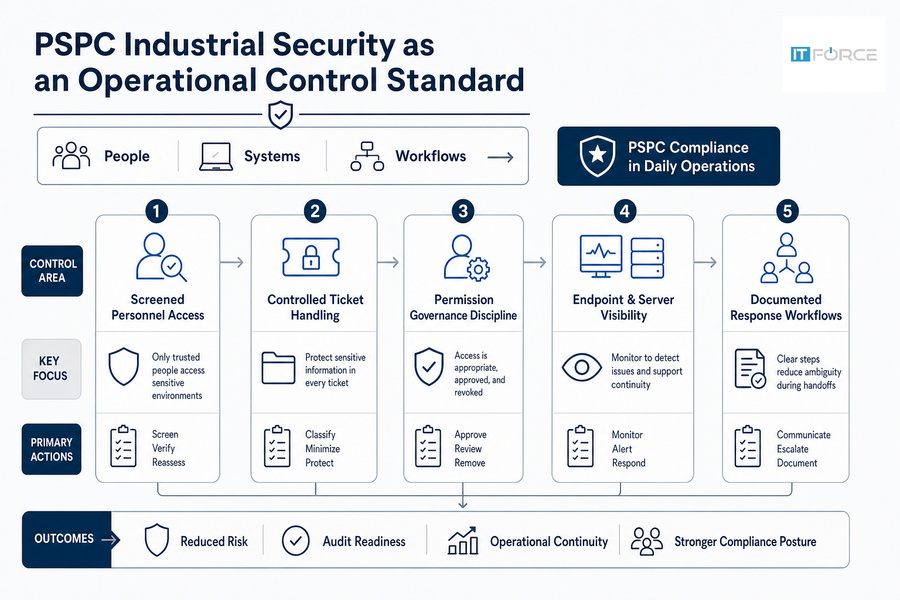
PSPC Industrial Security As An Operational Control Standard
Controlled goods compliance affects how people, systems, and workflows are governed. The practical question is whether PSPC industrial security expectations are reflected in how a technician handles a ticket, accesses a device, or escalates a server alert.
Assess whether your IT partner's everyday workflows support controlled-sector obligations when support touches identity, endpoints, servers, and network environments.
-
Screened personnel access: Personnel screening matters when technicians can view sensitive systems, file shares, or user records.
-
Controlled ticket handling: Tickets can contain drawings, screenshots, asset names, or employee details that should not be casually copied, forwarded, or stored.
-
Permission governance discipline: Active Directory and Microsoft 365 changes need least privilege, approval records, and removal when roles change.
-
Endpoint and server visibility: Monitoring supports issue detection, continuity, and audit readiness when a workstation, server, or network event affects sensitive operations.
-
Documented response workflows: Standardized communication and escalation reduce ambiguity during support handoffs.
Vetted IT Vendor Defence Sector Impact On Contract Readiness
Vendor readiness affects bid timelines, onboarding approvals, contract eligibility, and security officer confidence. A Vetted IT vendor defence sector evaluation should test whether supplier status, support workflows, and access boundaries match the contract environment.
-
Fewer procurement blockers: Certification supports vendor eligibility where CGP status is required before technical work begins.
-
Cleaner onboarding reviews: Screened status gives procurement and security teams a stronger starting point for review conversations.
-
Better support boundaries: Vendors must know what staff can access, store, discuss, or transfer during tickets, remote sessions, and escalation calls.
-
Clearer escalation paths: Structured ticketing and 24/7/365 support help protect continuity when an endpoint or server issue affects a deadline.
-
Stronger audit posture: Documented workflows support evidence gathering during review.
Procurement readiness then has to carry into service delivery. Network management, Microsoft 365 support, server monitoring, and endpoint management must operate within defined access and escalation controls.
Defence IT Support Canada And Nuclear Industry IT Services Canada
A workstation issue can expose more than a hardware fault when the user is working with controlled technical materials. The same applies to a Microsoft 365 permission change, server alert, or network access request. Defence IT support Canada and Nuclear industry IT services Canada require disciplined service boundaries, not generic help desk habits.
Aligning IT operations with controlled-sector requirements takes coordination across procurement, security, operations, and IT.
-
Map exposure points: Review which systems, folders, devices, and applications may expose vendors to controlled goods or technical information.
-
Confirm workflow fit: Check whether vendor personnel, ticket workflows, and escalation paths align with controlled goods obligations.
-
Validate access controls: Review Microsoft 365, Active Directory, Exchange, and network permissions against role-based access needs.
-
Escalate material gaps: Raise issues that affect contract eligibility, audit readiness, or business continuity.
Assess Controlled Sector IT Readiness
If your procurement process requires vetted IT support, talk with IT Force about readiness for defence, aerospace, or nuclear environments.
Security Cleared MSP And IT Provider Considerations Before Engagement
Buyers often use shorthand phrases during vendor searches, including Security cleared MSP, but controlled goods certification has a specific legal and operational meaning. Controlled Goods Certification is not the same as classified Secret or Top Secret clearance.
Separate marketing language from verifiable eligibility, process maturity, and support fit when selecting an IT provider.
-
Confirm certification scope: Ask what the certification permits, what it does not cover, and when client-side approvals still apply.
-
Review access workflows: Assess how tickets, approvals, remote access, and escalation are documented.
-
Test support responsiveness: Evaluate 24/7/365 coverage, workstation monitoring, server monitoring, and network management expectations.
-
Check contract flexibility: We offer flexible pricing, no monthly commitment, and no-risk trial periods where we do not take the client's money if unsatisfied.
Talk With IT Force About Controlled Sector IT Readiness
IT Force's Controlled Goods Certification supports eligibility for controlled sector engagements and reflects disciplined IT support practices across managed IT, cybersecurity, Microsoft 365, Active Directory, monitoring, network management, and support workflows.
Our approach is grounded in rigorous employee screening, structured communication, standardized ticketing and response workflows, and continuous monitoring.
If you are assessing vendor readiness, controlled information exposure, or managed IT support needs, talk with us about the systems, users, approvals, tickets, and escalation paths that matter most.
Where We Offer Cybersecurity Services