



Table of Contents
Tickets are piling up while Microsoft 365 permission issues slow purchase approvals, a server incident interrupts production reporting, and internal staff spend the morning resetting passwords instead of improving business systems. That is when leaders start evaluating the benefits of IT outsourcing, not as a staffing shortcut, but as a decision about operating capacity, response consistency, security exposure, budget predictability, and internal focus.
Outsourcing is not automatically better than in-house IT. It works when communication, ticket routing, security responsibilities, and business priorities are defined before the first request is assigned.
Jason Stitt, Co-Founder at IT Force, notes: "Outsourcing works best when expectations, response workflows, security responsibilities, and business priorities are documented first, so every ticket has context and every escalation has ownership."
Benefits Of IT Outsourcing For Operational Maturity
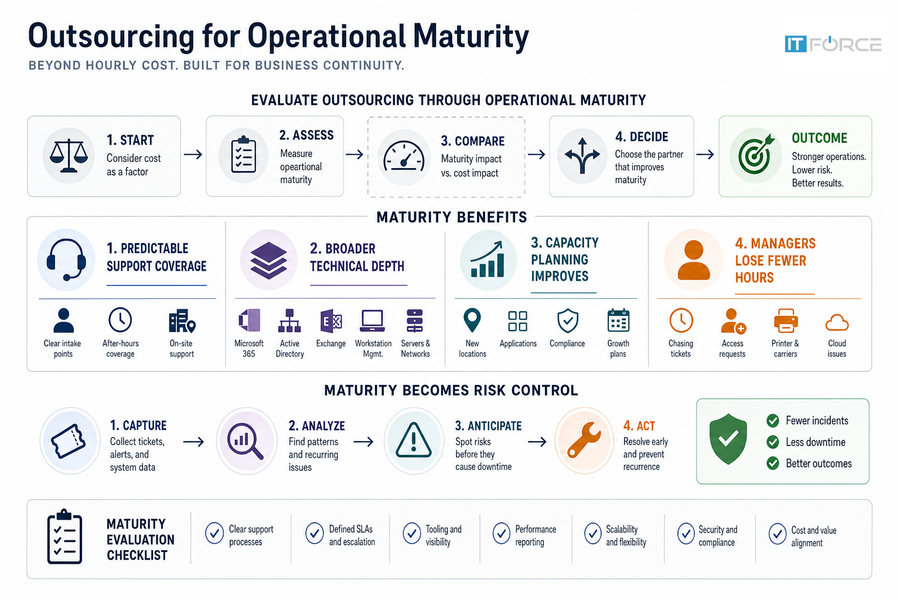
Outsourcing should be evaluated through operational maturity, not only hourly cost. Cost matters, and software development outsourcing research shows cost reduction is cited by 63% as a driver, but support maturity shows up in fewer stalled users, clearer escalation paths, and better visibility into recurring issues. The practical question is whether users know where to send requests, whether leaders can see ticket patterns, and whether response expectations are clear before a workstation failure, access issue, or server alert interrupts the day.
-
Predictable support coverage: Users have a defined path for workstation failures, on-site needs, and after-hours network incidents that affect order entry, approvals, or customer response.
-
Broader technical depth: Support can extend across Microsoft 365, Active Directory, Exchange, workstation management, server monitoring, and network management without depending on one overloaded generalist.
-
Improved capacity planning: New locations, applications, compliance requirements, and growth plans can be mapped into ticket volume, licensing needs, and project timelines.
-
Fewer lost management hours: Leaders spend less time chasing unresolved tickets, approving every small access request, or coordinating printer, carrier, and cloud vendors themselves.
That maturity becomes risk control when service data exposes patterns before they cause downtime.
Advantages Of Outsourcing IT Services When Internal Teams Are Overloaded
An internal IT lead or office manager often juggles onboarding requests, password resets, Microsoft 365 permissions, printer issues, vendor escalations, and security alerts while larger projects sit untouched. The advantages of outsourcing IT services include redistributing repeatable work so internal decision-makers can focus on system improvements, application choices, and operational deadlines. Research also shows 65% of organizations outsource to keep internal teams focused on core business, while 53% use outside partners to solve capability gaps.
What this looks like in practice. A manufacturer adding shop-floor workstations needs device setup, network access, and user permissions ready before a shift starts. With more than 25 years of manufacturing IT experience, we look at the workstation, the production workflow, and the support process together. A professional services firm onboarding users needs Microsoft 365 access and file permissions correct before client work begins.
Workload relief matters most when it connects to dependable capability, not just ticket deflection. End user support, Microsoft 365 administration, network management, and outsourced project management give repeatable work a clear owner while larger initiatives keep moving.
Benefits Of Outsourcing IT Services Across Security And Continuity
Security and continuity are workflow issues because incidents affect invoices, production schedules, approvals, customer response times, and compliance evidence. The benefits of outsourcing IT services are strongest when security work is tied to recovery priorities and operating decisions, not only alerts.
-
Continuous monitoring and response: Continuous monitoring and AI-driven threat detection help identify suspicious activity before it spreads across endpoints or shared mailboxes. Cybersecurity is a major driver, with 60% of respondents saying it was the top challenge that led them to work with an MSP.
-
Recovery priorities before storage: Backup and disaster recovery planning should define which systems return first, such as ERP, dispatch, payroll, or customer portals. A file restore is not enough if the approval workflow or production schedule remains unavailable.
-
Compliance evidence stays organized: Compliance and data security planning helps preserve access records, policy evidence, privacy obligations, and incident notes. For organizations handling controlled or sensitive work, our Controlled Goods Certification supports vetting and governance expectations.
-
Access control reduces exposure: Active Directory and Microsoft 365 permission reviews reduce orphaned accounts, excessive access, and approval gaps. That matters when a former employee still has mailbox access or a temporary permission never gets removed.
-
Continuity roles are assigned: Business continuity consulting clarifies who communicates, who approves recovery decisions, and who escalates vendors during an outage.
IT Outsourcing Pros And Cons In Vendor Selection
Outsourcing failures usually come from weak vendor selection, unclear scope, poor communication, or contracts that do not match operational realities. The IT outsourcing pros and cons are practical: a provider can improve coverage and expertise, but the wrong partner can hide ticket status, miss root causes, respond slowly, or leave users unable to work before a deadline. Poor vetting also creates security and compliance exposure when privileged access is handed to people, tools, or processes that were never properly reviewed.
Selection criteria should come before contract review because pricing alone will not show whether support matches your workflow. Check for structured communication, standardized ticketing and response workflows, rigorous employee screening, access controls, after-hours terms, project exclusions, licensing ownership, and how recurring issues are reported.
-
Review ticket handling: Ask how tickets are triaged, escalated, documented, and reported to leadership.
-
Confirm support coverage: Define response expectations for business hours, on-site needs, and after-hours incidents.
-
Vet security practices: Review certifications, employee screening, privileged access controls, and compliance fit.
-
Clarify commercial terms: Confirm flexible pricing, no-risk trial terms, no monthly commitment where offered, project pricing, license ownership, and exit conditions.
Strengthen IT Without Overloading Your Team
If tickets, security tasks, and support gaps are slowing your business, IT Force can help you evaluate the right outsourcing path.
IT Outsourcing Advantages And Disadvantages In A Hybrid Model
The decision is not binary. A business can retain internal ownership of strategy while outsourcing repeatable, specialized, or capacity-sensitive work. The IT outsourcing advantages and disadvantages become easier to manage when internal leaders keep business priorities, approvals, application decisions, and vendor strategy, while outsourced specialists handle help desk, monitoring, Microsoft 365, cybersecurity, cloud consulting, network consulting, project management, and business continuity planning.
The market reflects that depth. IDC reports that service providers as a group spent $65.6 billion on compute and storage infrastructure in 4Q24, showing the scale of the external provider ecosystem. Cloud decisions still need governance, since moving to Azure can streamline server deployment and save 40 hours of IT time per server in the cited composite example.
A hybrid model works when governance is explicit. Our outsourced vCIO guidance, outsourced project management, software licensing consulting, IT budgeting and planning, and IT roadmaps updated four times a year help connect technical work to operating priorities instead of letting support tickets, renewals, and projects compete without a decision process.
Organizational change is difficult because staff need clarity on who handles requests, approvals, exceptions, and escalations.
-
Map current IT work by frequency, risk, and business impact.
-
Identify work that creates recurring tickets or delays.
-
Decide which decisions must stay internal.
-
Assign escalation paths for incidents, projects, and compliance questions.
-
Review the model during roadmap updates and budget planning.
Choosing The Right Outsourcing Path With IT Force
Outsourcing works when you define benefits, risks, responsibilities, communication workflows, security expectations, and business priorities before support begins. We help clients assess the right mix of outsourced IT support, vCIO guidance, project management, Microsoft 365, network management, cloud consulting, business continuity, budgeting, and compliance planning.
If your team is still losing mornings to permission issues, password resets, unresolved tickets, or vendor escalations, contact us at IT Force for a practical conversation about what fits your operations, risk profile, and budget.
We can walk through structured communication, standardized ticketing and response workflows, flexible arrangements with no monthly commitment, and IT roadmaps updated three times a year.
Explore IT Services Near You